Crash course

Online crash course for chemistry class 12th - CBSE

Friday, September 1, 2023


Important Questions for Class 12 Chemistry Chapter 13Amines: Organic Compounds Containing Nitrogen Class 12 Important Questions

Amines: Organic Compounds Containing Nitrogen Class 12 Important Questions Very Short Answer Type

Question 1.
Why is an alkylamine more basic than ammonia? (Delhi 2009)
Answer:
Due to electron releasing inductive effect (+1) of alkyl group, the electron density on the nitrogen atom increases and thus, it can donate the lone pair of electrons more easily than ammonia.

Question 2.
Arrange the following compounds in an increasing order of basic strengths in their aqueous solutions : NH3, CH3NH2, (CH3)2NH, (CH3)3N (All India 2009)
Answer:
Basicity order (due to stability of ammonium cation)
(CH3)2 NH > CH3NH2 > (CH3)3 N > NH3

Question 3.
Give the IUPAC name of H2N — CH2—CH2—CH = CH2. (Delhi 2010)
Answer:
IUPAC name : But-3-ene-1-amine

Question 4.
Arrange the following compounds in an increasing order of their solubility in water : C6H5NH2, (C2H5)2NH, C2HSNH2 (Delhi & All India 2011)
Answer:
C6H5NH2 < (C2H5)2NH < C22H5NH2

Question 5.
Give a chemical test to distinguish between ethylamine and aniline. (All India 2011)
Answer:
Ethylamine and aniline :
By Azo dye test: It involves the reaction of any aromatic primary amine with HNO2(NaNO2 + dil. HCl) at 273-278 K followed by treatment with an alkaline solution of 2-naphthol when a brilliant yellow, orange or red coloured dye is obtained.
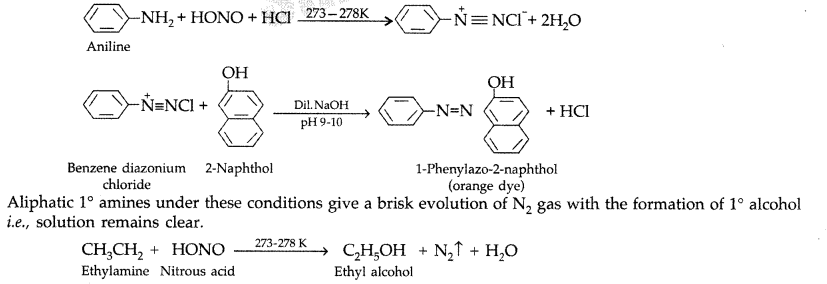
Important Questions for Class 12 Chemistry Chapter 13 Amines Organic Compounds Containing Nitrogen Class 12 Important Questions 1


Question 6.
Arrange the following in the decreasing order of their basic strength in aqueous solutions: CH3NH2, (CH3)2 NH, (CH3)3N and NH3 (Delhi 2012)
Answer:
(CH3)2 NH > CH3NH2 > (CH3)3 N > NH3

Question 7.
Arrange the following in increasing order of their basic strength in aqueous solution: CH3.NH2, (CH3)3N, (CH3)2NH (Delhi 2013)
Answer:

Important Questions for Class 12 Chemistry Chapter 13 Amines Organic Compounds Containing Nitrogen Class 12 Important Questions 2


Question 8.
Write the structure of 2-aminotoluene. (All India 2013)
Answer:
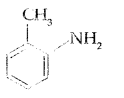
Important Questions for Class 12 Chemistry Chapter 13 Amines Organic Compounds Containing Nitrogen Class 12 Important Questions 3

Question 9.
Write the structure of n-methylethanamine. (All India 2013)
Answer:
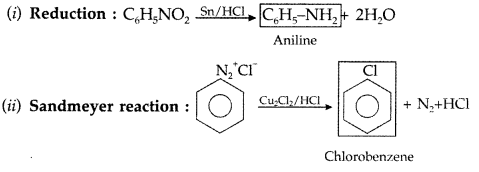
Structure of n-methylethanamine :
H3C—H2C—NH—CH2


Question 10.
Write the structure of prop-2-en-l-amine. (All India 2013)
Answer:
H2C=CH—H2C—NH2

Question 11.
How may methyl bromide be preferentially converted to methyl isocyanide? (Comptt. Delhi 2013)
Answer:
Bit carbylamine reaction:

Important Questions for Class 12 Chemistry Chapter 13 Amines Organic Compounds Containing Nitrogen Class 12 Important Questions 4

Question 12.
Arrange the following compounds in increasing order of solubility in water :
C6H5NH2, (C2H5)2NH, C2H5NH2 (Delhi 2014)
Answer:
C6H5NH2 < (C2H5)2NH < C2H5NH,

Question 13.
Arrange the following in increasing order of basic strength :
C6H5NH2, C6H5NHCH3, C6H5CH2NH2 (Delhi 2014)
Answer:
C6H5NH2 < C6H5NHCH3 < C6H5CH2NH2


Question 14.
Arrange the following in increasing order of basic strength :
C6H5NH2, C6H5NHCH3, C6H5N(CH3)2 (Delhi 2014)
Answer:
C6H5N(CH3)2 > C6H5NHCH3 > C6H5NH2

Question 15.
The conversion of primary aromatic amines into diazonium salts is known as (All India 2014)
Answer:
Diazotization.

Question 16.
Out of CH3—NH2 and (CH3)3N, which one has higher boiling point? (Comptt. Delhi 2014)
Answer:
CH3—NH2 has higher boiling point than (CH3)3N.

Question 17.
Complete the following reaction equation : (Comptt. Delhi 2015)
Answer:
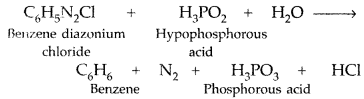
Important Questions for Class 12 Chemistry Chapter 13 Amines Organic Compounds Containing Nitrogen Class 12 Important Questions 5


Question 18.
Arrange the following in increasing order of basic strength (Comptt. All India 2015)
Aniline, p-Nitroaniline and p-Toluidine
Answer:

Important Questions for Class 12 Chemistry Chapter 13 Amines Organic Compounds Containing Nitrogen Class 12 Important Questions 6

Question 19.
Write the IUPAC name of the given compound: (Delhi 2016)
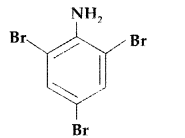
Important Questions for Class 12 Chemistry Chapter 13 Amines Organic Compounds Containing Nitrogen Class 12 Important Questions 7
Answer:
2, 4, 6-Tribromoaniline

Question 20.
Write IUPAC name of the following compound: (CH3CH2)2NCH3 (Delhi 2017)
Answer:
N-Ethyl-N-methylethanamine

Question 21.
Write the IUPAC name of the following compound: (Comptt. All India 2017)
CH3NHCH(CH3)2
Answer:
IUPAC name: N-Methylpropan-2-amine


Question 22.
Write the IUPAC name of the following compound: (Delhi 2017)
(CH3)2N-CH2CH3
Answer:
IUPAC name: N, N Dimethylamine

Question 23.
Write IUPAC name of the following compound : (Comptt. All India 2017)
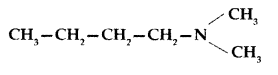
Important Questions for Class 12 Chemistry Chapter 13 Amines Organic Compounds Containing Nitrogen Class 12 Important Questions 8
Answer:
IUPAC name : N, N-Dimethylbutanamine.

Amines: Organic Compounds Containing Nitrogen Class 12 Important Questions Short Answer Type -I [SA – I]

Question 24.
Give the chemical tests to distinguish between the following pairs of compounds :
(i) Ethyl amine and Aniline
(ii) Aniline and Benzylamine (All India 2010)
Answer:
(i) Ethylamine and aniline :
By Azo dye test: It involves the reaction of any aromatic primary amine with HNO2(NaNO2 + dil. HCl) at 273-278 K followed by treatment with an alkaline solution of 2-naphthol when a brilliant yellow, orange or red coloured dye is obtained.
Important Questions for Class 12 Chemistry Chapter 13 Amines Organic Compounds Containing Nitrogen Class 12 Important Questions 1

(ii) Distinction between Aniline and Benzylamine :
By Nitrous acid test : Benzylamine reacts with HNO2 to form a diazonium salt which being unstable even at low temperature, decomposes with evolution of N2 gas

Important Questions for Class 12 Chemistry Chapter 13 Amines Organic Compounds Containing Nitrogen Class 12 Important Questions 9


Question 25.
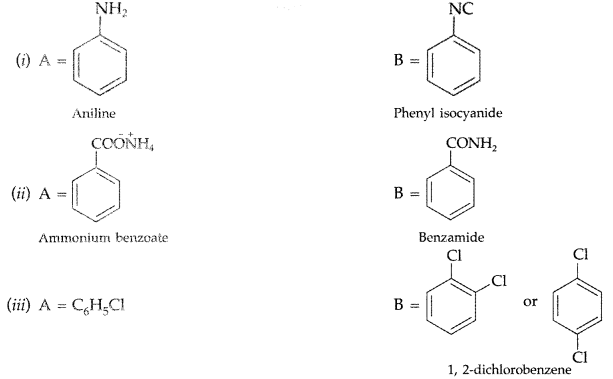
Identify A and B in each of the following processes : (All India 20100

Important Questions for Class 12 Chemistry Chapter 13 Amines Organic Compounds Containing Nitrogen Class 12 Important Questions 10
Answer:
Important Questions for Class 12 Chemistry Chapter 13 Amines Organic Compounds Containing Nitrogen Class 12 Important Questions 11

Question 26.
Give the chemical tests to distinguish between the following pairs of compounds :
(i) Methylamine and Dimethylamine
(ii) Aniline and N-methylaniline (All India 2010)
Answer:
(i) Methylamine and Dimethylamine :
By Carbylamine test: Methylamine being a primary amine gives this test but Dimethylamine being a secondary amine does not.
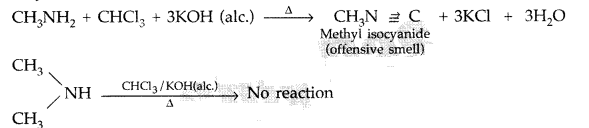
Important Questions for Class 12 Chemistry Chapter 13 Amines Organic Compounds Containing Nitrogen Class 12 Important Questions 12

(ii) Aniline and N-methylaniline
By Carbylamine test : Aniline is a 1° aromatic amine while N-methylaniline is a secondary aromatic amine. Therefore only 1° aromatic amine gives this test.

Important Questions for Class 12 Chemistry Chapter 13 Amines Organic Compounds Containing Nitrogen Class 12 Important Questions 13

Question 27.
Describe the following giving the relevant chemical equation in each case :
(i) Carbylamine reaction
(ii) Hofmann’s bromamide reaction (All India 2012)
Answer:
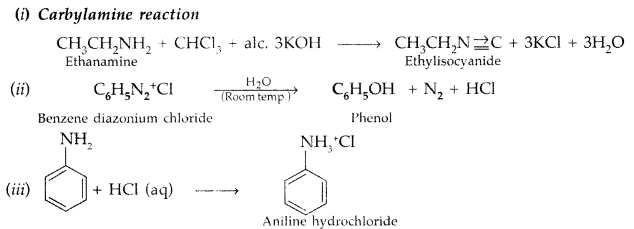
(i) Carbylamine reaction : Aliphatic and aromatic primary amines on heating with chloroform and ethanolic KOH form isocyanides or carbylamines which are foul smelling substances. This reaction is known as carbylamines reaction.

Important Questions for Class 12 Chemistry Chapter 13 Amines Organic Compounds Containing Nitrogen Class 12 Important Questions 14

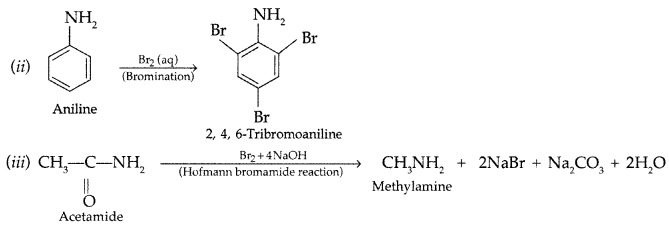
(ii) Hofmann’s bromamide reaction : Primary amines can be prepared by treating an amide with Br2 in an aqueous or alcoholic soln of NaOH.

Important Questions for Class 12 Chemistry Chapter 13 Amines Organic Compounds Containing Nitrogen Class 12 Important Questions 15

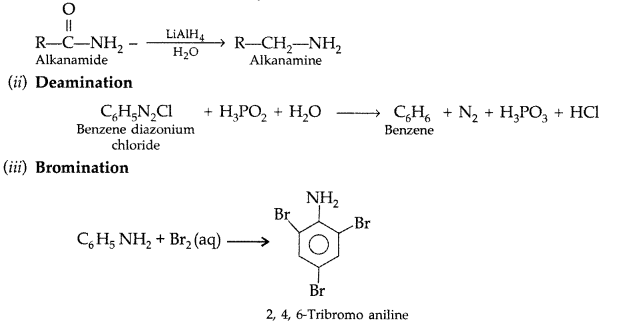
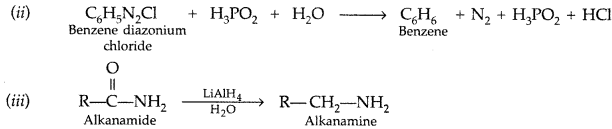
Question 28.
Complete the following reaction equations : (All India 2012)
(i) C6H5N2Cl + H3PO2 + H2O →
(ii) C6H5NH2 + Br2 (aq) →
Answer:
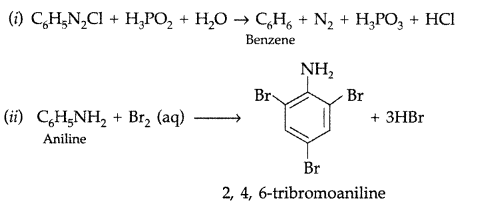
Important Questions for Class 12 Chemistry Chapter 13 Amines Organic Compounds Containing Nitrogen Class 12 Important Questions 16

Question 29.
Give IUPAC names of the following compounds : (Comptt. Delhi 2012)
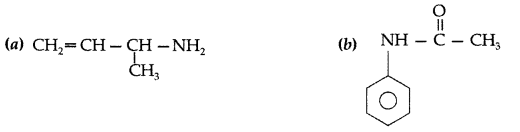
Important Questions for Class 12 Chemistry Chapter 13 Amines Organic Compounds Containing Nitrogen Class 12 Important Questions 17
Answer:
(a) IUPAC name : Methyl prop-2-en-1-amine
(b) IUPAC name : Phenyl acetamide

Question 30.
How are the following conversions carried out :
(a) Aniline to p-hydroxyazobenzene
(b) Ethanoyl chloride to Ethanenitrile. (Comptt. Delhi 2012)
Answer:
(a) Aniline to p-hydroxyazobenzene
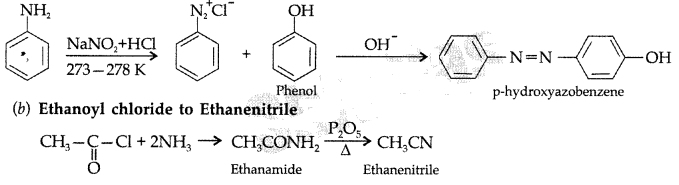
Important Questions for Class 12 Chemistry Chapter 13 Amines Organic Compounds Containing Nitrogen Class 12 Important Questions 18

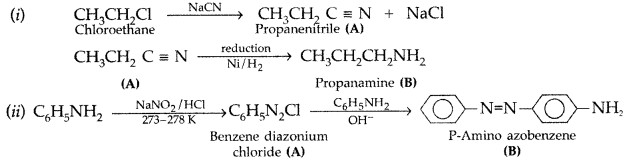
Question 31.
How are the following conversions carried out?
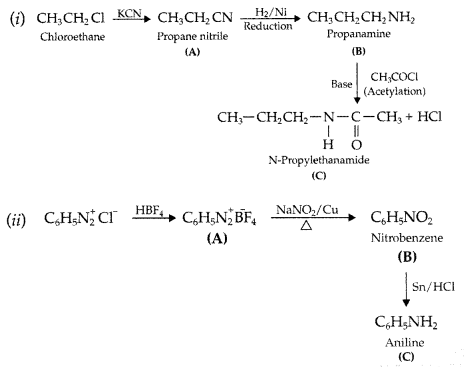
(i) CH3CH2Cl to CH3CH2CH2NH2
(ii) Benzene to aniline (Comptt. Delhi 2012)
Answer:
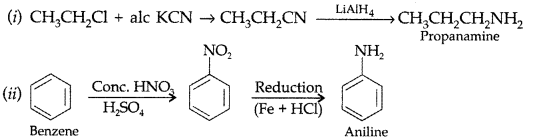
Important Questions for Class 12 Chemistry Chapter 13 Amines Organic Compounds Containing Nitrogen Class 12 Important Questions 19

Question 32.
How would you account for the following :
(a) Aniline is a weaker base than cyclohexyl amine.
(b) Methylamine in aqueous medium gives reddish-brown precipitate with FeCl3. (Comptt. All India 2012)
Answer:
(a) In aniline, the lone pair of electrons on the N-atom is delocalised over the benzene ring. As a result, the electron density on the nitrogen decreases.
But in cyclohexylamine, the lone pair of electrons on N-atom is readily available due to absence of reelections. Hence aniline is weaker base than cyclohexylamine.
(b) Methylamine being more basic than H2O, it accepts a proton from water liberating OH ions.
Important Questions for Class 12 Chemistry Chapter 13 Amines Organic Compounds Containing Nitrogen Class 12 Important Questions 20

Question 33.
How would you account for the following :
(a) Electrophilic susbstitution in case of aromatic amines takes place more readily than benzene.
(b) Ethanamide is a weaker base than ethanamine. (Comptt. All India 2012)
Answer:
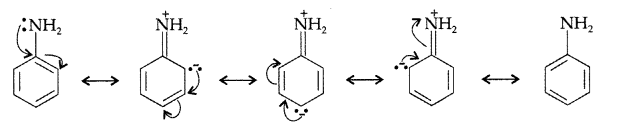
(a) Aniline exists as a resonance hybrid of the following five structures :
Important Questions for Class 12 Chemistry Chapter 13 Amines Organic Compounds Containing Nitrogen Class 12 Important Questions 21
The electron density is maximum at ortho and para positions to the – NH2 group. But in benzene there is no delocalisation of electron at any position and hence electrophilic substitution in case of aromatic amines takes place more readily than benzene.

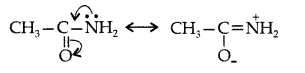
(b) In ethanamide the lone pair of electron of N-atom is not available due to resonance structure
Important Questions for Class 12 Chemistry Chapter 13 Amines Organic Compounds Containing Nitrogen Class 12 Important Questions 22
So it is a weaker base.

Question 34.
Illustrate the following reactions :
(a) Sandmeyer’s reaction
(b) Coupling reaction (Comptt. All India 2012)
Answer:
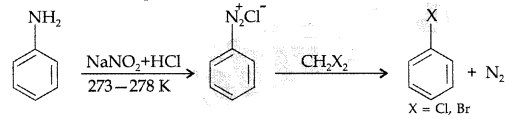
(a) Sandmeyer’s reaction : Aniline reacts with NaNO2 in HCl at 273 – 278 K giving diazonium salt which further reacts with cuprous chloride/bromide to give chloro or bromo benzene.
Important Questions for Class 12 Chemistry Chapter 13 Amines Organic Compounds Containing Nitrogen Class 12 Important Questions 23
This reaction is Sandmeyer’s reaction.
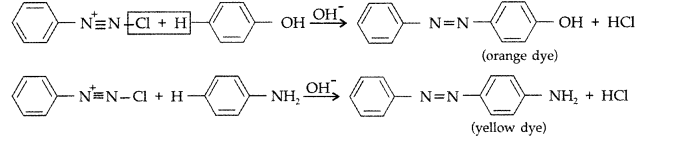
(b) Coupling reaction : Arene diazonium salts react with highly reactive aromatic compounds such as phenols and amines to form brightly coloured azo compounds.
Ar – N = N – Ar. This reaction is known as coupling reaction.
Important Questions for Class 12 Chemistry Chapter 13 Amines Organic Compounds Containing Nitrogen Class 12 Important Questions 24

Question 35.
Give chemical tests to distinguish between the following pairs of compounds :
(a) Aniline and Ethylamine
(b) Ethylamine and Dimethylamine (Comptt. Delhi 2013)
Answer:
(a) Ethylamine and aniline :
By Azo dye test: It involves the reaction of any aromatic primary amine with HNO2(NaNO2 + dil. HCl) at 273-278 K followed by treatment with an alkaline solution of 2-naphthol when a brilliant yellow, orange or red coloured dye is obtained.
Important Questions for Class 12 Chemistry Chapter 13 Amines Organic Compounds Containing Nitrogen Class 12 Important Questions 1

(b) Ethylamine and dimethylamine can be distinguished by the carbylamine test.
Carbylamine test: Aliphatic and aromatic amines on heating with chloroform and ethanolic potassium hydroxide form foul smelling isocyanides or carbylamines. Ethylamine (being an aliphatic primary amine) gives a positive carbylamine test, but dimethylamine does not.

Important Questions for Class 12 Chemistry Chapter 13 Amines Organic Compounds Containing Nitrogen Class 12 Important Questions 25

Question 36.
Explain the following reactions :
(a) Gabriel Phthalimide reaction
(b) Coupling reaction (Comptt. Delhi, Comptt. All India 2013)
Answer:
(a) Gabriel phthalimide synthesis : It is used to prepare 1° amine (Primary amine). The starting compound is a phthalimide. But aromatic primary amines cannot be prepared by this method because aryl halides do not undergo nucleophilic substitution with the anion formed by phthalimide.
Example :
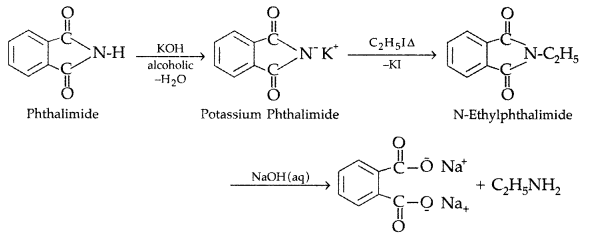
Important Questions for Class 12 Chemistry Chapter 13 Amines Organic Compounds Containing Nitrogen Class 12 Important Questions 26

(b) Coupling reaction : Arene diazonium salts react with highly reactive aromatic compounds such as phenols and amines to form brightly coloured azo compounds.
Ar – N = N – Ar. This reaction is known as coupling reaction.
Important Questions for Class 12 Chemistry Chapter 13 Amines Organic Compounds Containing Nitrogen Class 12 Important Questions 24

Question 37.
Give reasons :
(a) Aniline is a weaker base than cyclohexyl amine.
(b) It is difficult to prepare pure amines by ammonolysis of alkyl halides. (Comptt. All India 2013)
Answer:
(a) In aniline, the lone pair of electrons on the N-atom is delocalised over the benzene ring. As a result, the
electron density on the nitrogen decreases.
But in cyclohexylamine, the lone pair of electrons on N-atom is readily available due to absence of π-electrons. Hence aniline is weaker base than cyclohexylamine.
(b) Because the primary amine formed by ammonolysis itself acts as a nucleophile and produces further 2° and 3° alkyl amine.

Question 38.
Give reasons :
(i) Electrophilic substitution in aromatic amines takes place more readily than benzene.
(ii) CH3CONH2 is weaker base than CH3CH2NH2. (Comptt. All India 2013)
Answer:
(i) Due to the strong activating effect of the NH2 group, aromatic amines undergo electrophilic substitution reactions readily than benzene.
(ii) In case of acetamide due to resonance, the lone pair of electrons on the nitrogen atom is delocalized over keto group which decreases electron density hence less basic while in ethylamine due to +1 effect of ethyl group electron density increases on N-atom and hence basic character increases.

Question 39.
(i) Arrange the following compounds in an increasing order of basic strength :
C6H5NH2, C6H5N(CH3)2, (C2H5)2NH and CH3NH2
(ii) Arrange the following compounds in a decreasing order of pKb values :
C2H5NH2, C6H5NHCH3, (C2H5)2NH and C6H5NH (Comptt. Delhi 2014)
Answer:
(i) Increasing order of basic strength

Important Questions for Class 12 Chemistry Chapter 13 Amines Organic Compounds Containing Nitrogen Class 12 Important Questions 27
(ii) Decreasing order of pKb values
C6H5NH2 < C6H5NHCH3 < C2H5NH2 < (C2H5)2NH

Question 40.
Give a chemical test to distinguish between each of the following pairs of compounds :
(i) Ethylamine and Aniline
(ii) Aniline and Benzylamine (Comptt. All India 2014)
Answer:
(i) Ethylamine and aniline :
By Azo dye test: It involves the reaction of any aromatic primary amine with HNO2(NaNO2 + dil. HCl) at 273-278 K followed by treatment with an alkaline solution of 2-naphthol when a brilliant yellow, orange or red coloured dye is obtained.
Important Questions for Class 12 Chemistry Chapter 13 Amines Organic Compounds Containing Nitrogen Class 12 Important Questions 1

(ii) Distinction between Aniline and Benzylamine :
By Nitrous acid test : Benzylamine reacts with HNO2 to form a diazonium salt which being unstable even at low temperature, decomposes with evolution of N2 gas
Important Questions for Class 12 Chemistry Chapter 13 Amines Organic Compounds Containing Nitrogen Class 12 Important Questions 9

Question 41.
Write the chemical equations involved in the following reactions: (All India 2016)
(i) Hoffmann-bromamide degradation reaction
(ii) Carbylamine reaction
Answer:
(i) Hoffmann’s bromamide reaction : In this reaction, migration of an alkyl or aryl group takes place from carbonyl carbon of the amide to the nitrogen atom. Therefore the amine so formed has one carbon atom less than that of amide.
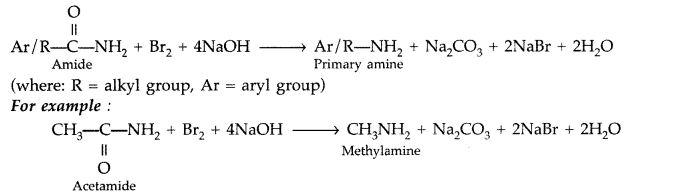
Important Questions for Class 12 Chemistry Chapter 13 Amines Organic Compounds Containing Nitrogen Class 12 Important Questions 28

(ii) Carbylamine reaction. This reaction is used to distinguish primary amines from 2° and 3° amines as it is only given by 1° amines with the production of a very bad smelling organic compound.
For example :

Important Questions for Class 12 Chemistry Chapter 13 Amines Organic Compounds Containing Nitrogen Class 12 Important Questions 29

Amines: Organic Compounds Containing Nitrogen Class 12 Important Questions Short Answer Type -II [SA – II]

Question 42.
Giving an example for each describe the following reactions :
(i) Hofmann’s bromamide reaction
(ii) Gatterman reaction
(iii) A coupling reaction (Delhi 2009)
Answer:
(i) Hofmann’s bromamide reaction : When amide is treated with bromide in alkaline solution, an amide yields an amine containing one carbon less than the starting amide.
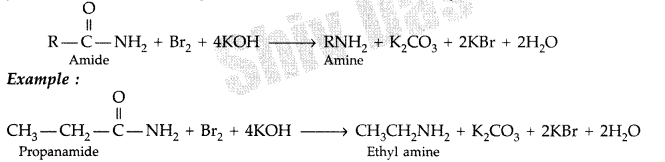
Important Questions for Class 12 Chemistry Chapter 13 Amines Organic Compounds Containing Nitrogen Class 12 Important Questions 30

(ii) Gatterman reaction: When benzene or its derivative is treated with carbon monoxide and hydrogen chloride in the presence of anhydrous aluminium chloride or cuprous chloride, it gives benzaldehyde or substituted benzaldehyde.
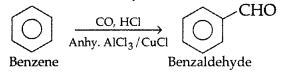
Important Questions for Class 12 Chemistry Chapter 13 Amines Organic Compounds Containing Nitrogen Class 12 Important Questions 31
Gattermann Koch reaction : Diazonium salt reacts with hydrogen halide in presence of copper powder giving haloarene.
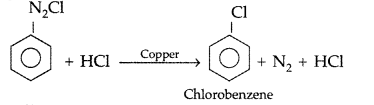
Important Questions for Class 12 Chemistry Chapter 13 Amines Organic Compounds Containing Nitrogen Class 12 Important Questions 32

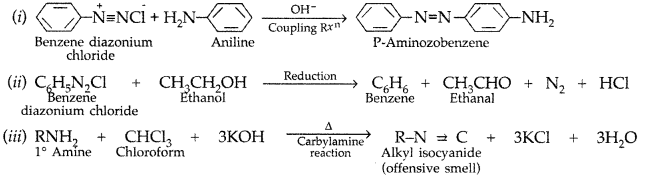
(iii) A coupling reaction : Arene diazonium salts react with highly reactive aromatic compounds such as phenols and amines to form brightly coloured azo compounds.
Ar – N = N – Ar. This reaction is known as coupling reaction.
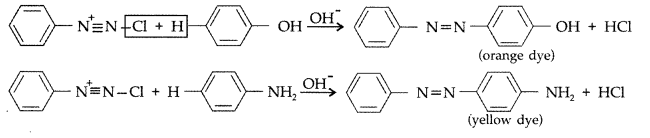
Important Questions for Class 12 Chemistry Chapter 13 Amines Organic Compounds Containing Nitrogen Class 12 Important Questions 33

Question 43.
Complete the following reaction equations: (All India 2009)

Important Questions for Class 12 Chemistry Chapter 13 Amines Organic Compounds Containing Nitrogen Class 12 Important Questions 34
Answer:
Reduction reaction
Important Questions for Class 12 Chemistry Chapter 13 Amines Organic Compounds Containing Nitrogen Class 12 Important Questions 35

Question 44.
Complete the following reaction equations :
(i) C6H5Cl + CH3COCl →
(ii) C2H5NH2 + C6H5SO2Cl →
(iii) C2H5NH2 + HNO2 →
Answer:
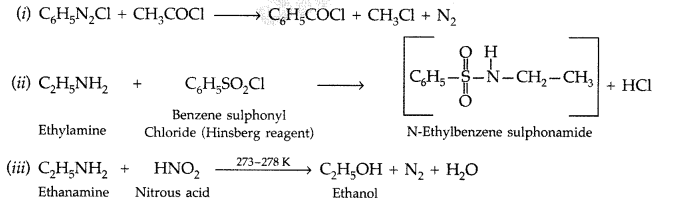
Important Questions for Class 12 Chemistry Chapter 13 Amines Organic Compounds Containing Nitrogen Class 12 Important Questions 36

Question 45.
In the following cases rearrange the compounds as directed : (Delhi 2010)
(i) In an increasing order of basic strength :
C6H5NH2, C6H5 N(CH3)2, (C2H5)2NH and CH3NH2
(ii) In a decreasing order of basic strength :
Aniline, p-nitroaniline and p-toluidine
(iii) In an increasing order of pKb values :
C2H5NH2, C6H5 NHCH3, (C2H5)2NH and C6H5NH2
Answer:
(i) Order of basic strength :
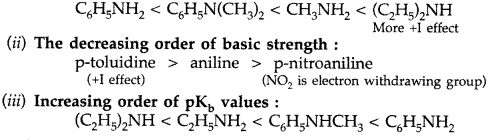
Important Questions for Class 12 Chemistry Chapter 13 Amines Organic Compounds Containing Nitrogen Class 12 Important Questions 37
Since a stronger base has a lower pKb value therefore basic strength order.
(C2H5)2NH > C2H5NH2 > C6H5NHCH3 > C6H5NH2

Question 46.
Complete the following chemical equations : (Delhi)

Important Questions for Class 12 Chemistry Chapter 13 Amines Organic Compounds Containing Nitrogen Class 12 Important Questions 38
Answer:
Important Questions for Class 12 Chemistry Chapter 13 Amines Organic Compounds Containing Nitrogen Class 12 Important Questions 39

Question 47.
(a) Explain why an alkylamine is more basic than ammonia?
(b) How would you convert
(i) Aniline to nitrobenzene (ii) Aniline to iodobenzene (Delhi 2011)
Answer:
(a) Due to electron releasing inductive effect (+1) of alkyl group, the electron density on the nitrogen atom increases and thus, it can donate the lone pair of electrons more easily than ammonia.

(b) (i) Aniline to nitrobenzene
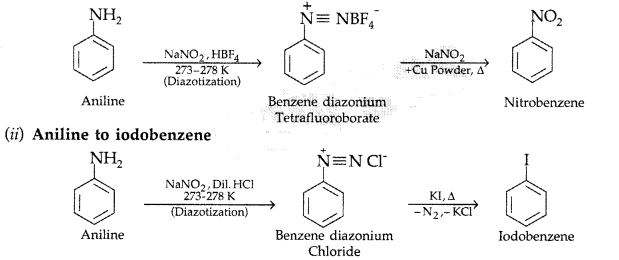
Important Questions for Class 12 Chemistry Chapter 13 Amines Organic Compounds Containing Nitrogen Class 12 Important Questions 40

Question 48.
Complete the following chemical equations: (Delhi 2011)

Important Questions for Class 12 Chemistry Chapter 13 Amines Organic Compounds Containing Nitrogen Class 12 Important Questions 41
Answer:
Important Questions for Class 12 Chemistry Chapter 13 Amines Organic Compounds Containing Nitrogen Class 12 Important Questions 85
Important Questions for Class 12 Chemistry Chapter 13 Amines Organic Compounds Containing Nitrogen Class 12 Important Questions 42

Question 49.
State reasons for the following :
(i) pKb value for aniline is more than that for methylamine.
(ii) Ethylamine is soluble in water whereas aniline is not soluble in water.
(iii) Primary amines have higher boiling points than tertiary amines. (All India 2011)
Answer:
(i) Higher the pKb value, lower will be the basicity therefore aniline is less basic than methylamine because the
lone pair of electrons on nitrogen atom gets delocalized over the benzene ring are unavailable for protonation due to resonance in aniline which is absent in case of alkylamine.
(ii) Ethylamine is soluble in water due to its capability to form H-bonds with water while aniline is insoluble in water due to larger hydrocarbon part which tends to retard the formation of H-bonds.
(iii) Due to presence of two H-atoms on N-atom of primary amines, they undergo extensive intermolecular H-bonding while tertiary amines due to the absence of a H-atom on the N-atom, do not undergo H- bonding. As a result, primary amines have higher boiling points than 3° amines.

Question 50.
Write chemical equations for the following conversions :
(i) Nitrobenzene to benzoic acid.
(ii) Benzyl chloride to 2-phenylethanamine
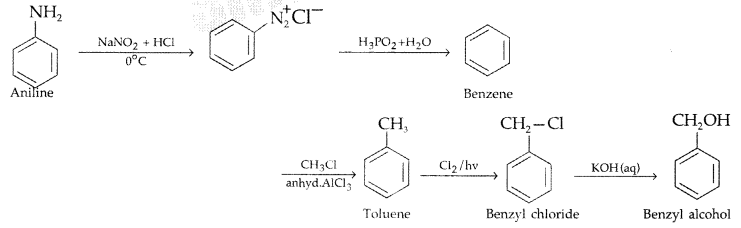
(iii) Aniline to benzyl alcohol. (Delhi 2012)
Answer:
(i) Nirtobenzene to benzoic acid :
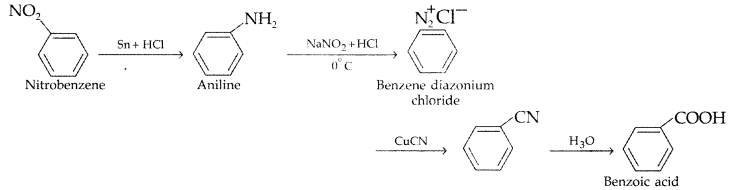
Important Questions for Class 12 Chemistry Chapter 13 Amines Organic Compounds Containing Nitrogen Class 12 Important Questions 43
(ii) Benzyl chloride to 2-phenylethanamine

Important Questions for Class 12 Chemistry Chapter 13 Amines Organic Compounds Containing Nitrogen Class 12 Important Questions 44
(iii) Aniline to benzyl alcohol
Important Questions for Class 12 Chemistry Chapter 13 Amines Organic Compounds Containing Nitrogen Class 12 Important Questions 45

Question 51.
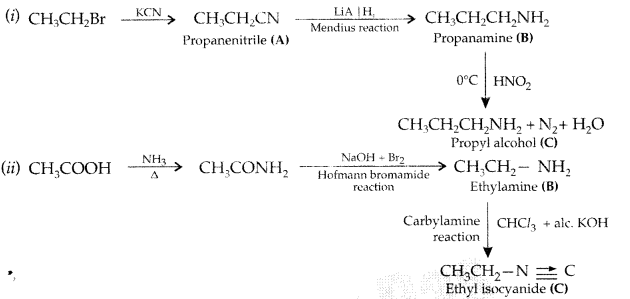
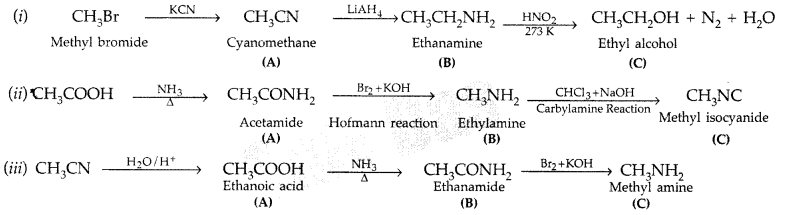
Give the structure of A, B and C in the following reactions: (Delhi 2013)

Important Questions for Class 12 Chemistry Chapter 13 Amines Organic Compounds Containing Nitrogen Class 12 Important Questions 46
Answer:
Important Questions for Class 12 Chemistry Chapter 13 Amines Organic Compounds Containing Nitrogen Class 12 Important Questions 47
Important Questions for Class 12 Chemistry Chapter 13 Amines Organic Compounds Containing Nitrogen Class 12 Important Questions 48

Question 52.
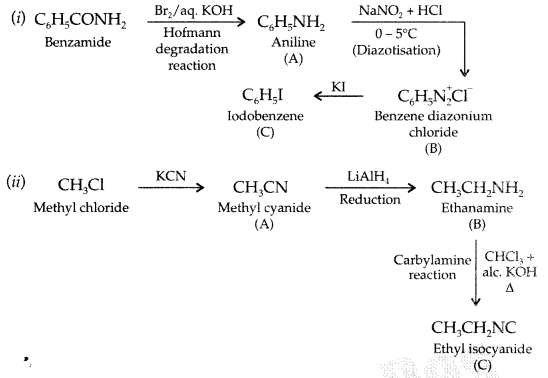
Give the structure of A, B and C in the following reactions : (Delhi 2013)

Important Questions for Class 12 Chemistry Chapter 13 Amines Organic Compounds Containing Nitrogen Class 12 Important Questions 49
Answer:
Important Questions for Class 12 Chemistry Chapter 13 Amines Organic Compounds Containing Nitrogen Class 12 Important Questions 50

Question 53.
Complete the following reactions : (All India 2013)

Important Questions for Class 12 Chemistry Chapter 13 Amines Organic Compounds Containing Nitrogen Class 12 Important Questions 51
Answer:
Important Questions for Class 12 Chemistry Chapter 13 Amines Organic Compounds Containing Nitrogen Class 12 Important Questions 52

Question 54.
Write the main products of following reactions: (All India 2013)
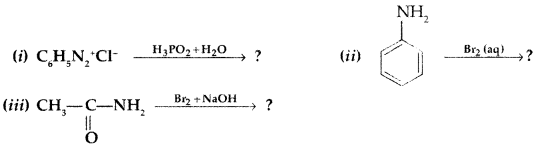
Important Questions for Class 12 Chemistry Chapter 13 Amines Organic Compounds Containing Nitrogen Class 12 Important Questions 53
Answer:
Important Questions for Class 12 Chemistry Chapter 13 Amines Organic Compounds Containing Nitrogen Class 12 Important Questions 54
Important Questions for Class 12 Chemistry Chapter 13 Amines Organic Compounds Containing Nitrogen Class 12 Important Questions 55

Question 55.
Give the structures of A, B and C in the following reactions : (Delhi 2014)
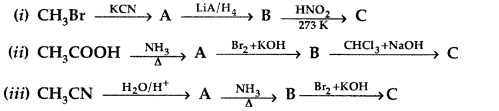
Important Questions for Class 12 Chemistry Chapter 13 Amines Organic Compounds Containing Nitrogen Class 12 Important Questions 56
Answer:
Important Questions for Class 12 Chemistry Chapter 13 Amines Organic Compounds Containing Nitrogen Class 12 Important Questions 57

Question 56.
How will you convert the following :
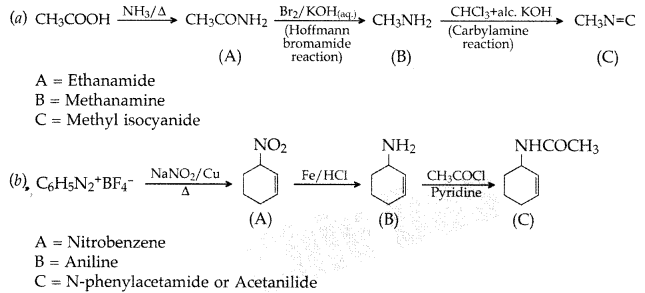
(i) Nitrobenzene into aniline
(ii) Ethanoic acid into methanamine
(iii) Aniline into N-phenylethanamide
(Write the chemical equations involved) (Delhi 2014)
Answer:
(i) Nitrobenzene into aniline
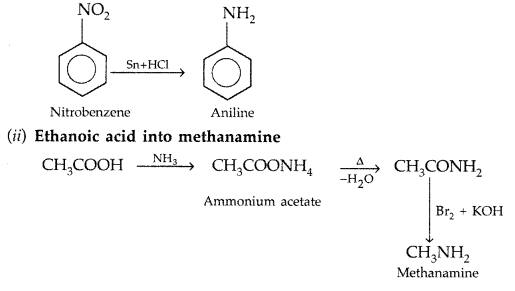
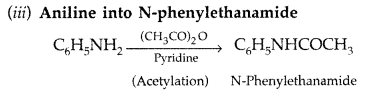
Important Questions for Class 12 Chemistry Chapter 13 Amines Organic Compounds Containing Nitrogen Class 12 Important Questions 58
Important Questions for Class 12 Chemistry Chapter 13 Amines Organic Compounds Containing Nitrogen Class 12 Important Questions 59

Question 57.
Account for the following :
(i) Primary amines (R-NH2) have higher boiling point than tertiary amines (R3N).
(ii) Aniline does not undergo Friedel – Crafts reaction.
(iii) (CH3)2NH is more basic than (CH3)3N in an aqueous solution. (All India 2014)
Answer:
(i) Due to presence of two H-atoms on N-atom of primary amines, they undergo extensive intermolecular H-bonding while tertiary amines due to the absence of a H-atom on the N-atom, do not undergo H- bonding. As a result, primary amines have higher boiling points than 3° amines.
(ii) Aniline being a Lewis base reacts with Lewis acid AlCl3 to form a salt.

Important Questions for Class 12 Chemistry Chapter 13 Amines Organic Compounds Containing Nitrogen Class 12 Important Questions 60
As a result, N of aniline acquires positive charge and hence it acts as a strong deactivating group for electrophilic substitution reaction. Consequently, aniline does not undergo Freidel Craft reaction.
(iii) Due to more steric hindrance in (CH3)3N it is less basic than (CH3)2NH.

Question 58.
Account for the following:
(i) Aniline does not give Friedel-Crafts reaction.
(ii) Ethylamine is soluble in water whereas aniline is not.
(iii) pKb of methylamine is less than that of aniline. (Comptt. Delhi 2014)
Answer:
(i) Aniline being a Lewis base reacts with Lewis acid AlCl3 to form a salt.

Important Questions for Class 12 Chemistry Chapter 13 Amines Organic Compounds Containing Nitrogen Class 12 Important Questions 61
As a result, N of aniline acquires positive charge and hence it acts as a strong deactivating group for electrophilic substitution reaction. Consequently, aniline does not undergo Freidel Craft reaction.
(ii) Ethylamine is soluble in water due to its capability to form Fl-bonds with water while aniline is insoluble in water due to larger hydrocarbon part which tends to retard the formation of H-bonds.
(iii) In aniline due to resonance lone pair of electron of nitrogen atom is delocalised due to which it is weaker base than methyl amine.
Hence Aniline has high pKb molecule i.e., methylamine has less pKb molecule.

Question 59.
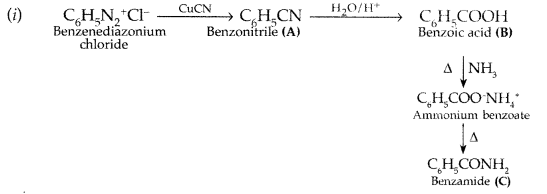
An aromatic compound ‘A’ on treatment with aqueous ammonia and heating forms compound ‘B’ which on heating with Br2 and KOH forms a compound ‘C’ of molecular formula C6H7N. Write the structures and IUPAC names of compounds A, B and C. (Comptt. Delhi 2015)
Answer:
The data shows that C6H7N may be C6H5NH2 i.e. Aniline. Since it is obtained by heating with Br2 and KOH (Hoffmann bromamide reaction), then the compound ‘B’ is Benzamide C6H5CONH2 which is in turn obtained by reaction with aqueous ammonia then the compound ‘A’ can be Benzoic acid i.e. C6H5COOH
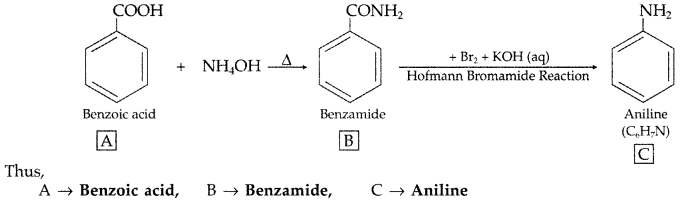
Important Questions for Class 12 Chemistry Chapter 13 Amines Organic Compounds Containing Nitrogen Class 12 Important Questions 62

Question 60.
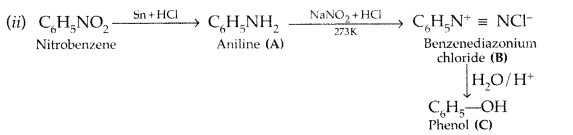
Write the structures A, B and C in the following : (Delhi 2016)

Important Questions for Class 12 Chemistry Chapter 13 Amines Organic Compounds Containing Nitrogen Class 12 Important Questions 63
Answer:
Important Questions for Class 12 Chemistry Chapter 13 Amines Organic Compounds Containing Nitrogen Class 12 Important Questions 64

Question 61.
Give reasons for the following:
(i) Aniline does not undergo Friedal-Crafts reaction.
(ii) (CH3)2 NH is more basic than (CH3)3 N in an aqueous solution.
(iii) Primary amines have higher boiling point than tertiary amines. (All India 2016)
Answer:
(i) Aniline being a Lewis base reacts with Lewis acid AlCl3 to form a salt.

Important Questions for Class 12 Chemistry Chapter 13 Amines Organic Compounds Containing Nitrogen Class 12 Important Questions 65
As a result, N of aniline acquires positive charge and hence it acts as a strong deactivating group for electrophilic substitution reaction. Consequently, aniline does not undergo Freidel Crafts reaction.
(ii) In (CH3)N there is maximum steric hindrance and least solvation but in (CH3)2NH the solvation is more and the steric hindrance is less than in (CH3)3NH; although + I effect is less, since there are two methyl groups; di-methyl amine is still a stronger base than tri-methyl.
(iii) Due to presence of two H-atoms on N-atom of primary amines, they undergo extensive intermolecular H-bonding while tertiary amines due to the absence of a H-atom on the N-atom, do not undergo H- bonding. As a result, primary amines have higher boiling points than 3° amines.

Question 62.
Write major product(s) in the following reactions : (Comptt. Delhi 2016)
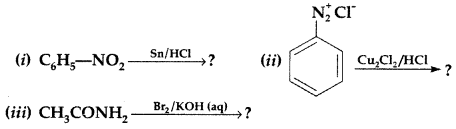
Important Questions for Class 12 Chemistry Chapter 13 Amines Organic Compounds Containing Nitrogen Class 12 Important Questions 66
Answer:
Important Questions for Class 12 Chemistry Chapter 13 Amines Organic Compounds Containing Nitrogen Class 12 Important Questions 67
Important Questions for Class 12 Chemistry Chapter 13 Amines Organic Compounds Containing Nitrogen Class 12 Important Questions 68

Question 63.
Describe a method for the identification of primary, secondary and tertiary amines. Also write chemical equations of the reaction involved. (Comptt. Delhi 2016)
Answer:
Benzenesulphonyl chloride (C6H5SO2Cl), which is also known as Hinsberg’s reagent, reacts with primary and secondary amines to form sulphonamides and tertiary amine does not react.
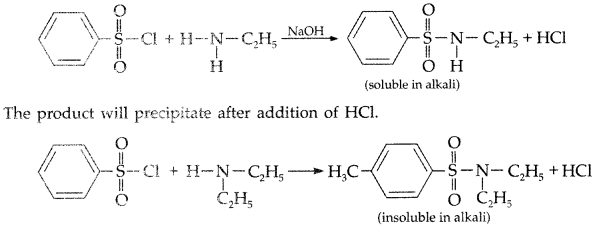
Important Questions for Class 12 Chemistry Chapter 13 Amines Organic Compounds Containing Nitrogen Class 12 Important Questions 69
It does not react with tertiary amines.

Question 64.
Write the products A and B in the following : (Comptt. All India 2016)
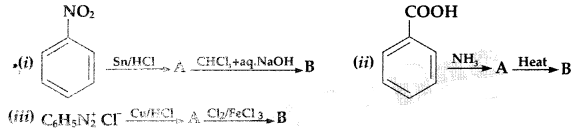
Important Questions for Class 12 Chemistry Chapter 13 Amines Organic Compounds Containing Nitrogen Class 12 Important Questions 70
Answer:
Important Questions for Class 12 Chemistry Chapter 13 Amines Organic Compounds Containing Nitrogen Class 12 Important Questions 71

Question 65.
Give reasons:
(i) Acetylation of aniline reduces its activation effect,
(ii) CH3NH2 is more basic than C6H5NH2.
(iii) Although —NH2 is o/p directing group, yet aniline on nitration gives a significant amount of m-nitroaniline. (Delhi 2017)
Answer:
(i) Acetylation of aniline reduces its activation effect because acetyl group being electron withdrawing group attracts the lone pair of electrons of the N-atom towards carboxyl group and the lone pair of electrons on N is less available for donation to benzene ring by resonance.
(ii) CH3NH2 is more basic than aniline due to availability of lone pair of electrons for donation while in aniline lone pair of electrons on the nitrogen atom is delocalised over benzene ring and thus unavailable for donation.
(iii) Because of nitration in an acidic medium, aniline gets protonated to give anilinium ion which is indirecting.

Question 66.
Give reasons for the following:
(a) Acetylation of aniline reduces its activation effect.
(b) CH3NH2 is more basic than C6H5NH2.
(c) Although —NH2 is o/p directing group, yet aniline on nitration gives a significant amount of m-nitroaniline. (All India 2017)
Answer:
(i) Acetylation of aniline reduces its activation effect because acetyl group being electron withdrawing group attracts the lone pair of electrons of the N-atom towards carboxyl group and the lone pair of . electrons on N is less available for donation to benzene ring by resonance.
(ii) CH3NH2 is more basic than aniline due to availability of lone pair of electrons for donation while in aniline lone pair of electrons on the nitrogen atom is delocalised over benzene ring and thus unavailable for donation.
(iii) Because of nitration in an acidic medium, aniline gets protonated to give anilinium ion which is indirecting.

Question 67.
Write the structures of compounds A, B and C in each of the following reactions: (All India 2017)

Important Questions for Class 12 Chemistry Chapter 13 Amines Organic Compounds Containing Nitrogen Class 12 Important Questions 72
Answer:
Important Questions for Class 12 Chemistry Chapter 13 Amines Organic Compounds Containing Nitrogen Class 12 Important Questions 73

Question 68.
Illustrate Sandmeyer’s reaction with the help of a suitable example. (Comptt. Delhi 2017)
Answer:
Sandmeyer’s reaction: The substitution of diazo group of benzene diazonium chloride by Chloro, Bromo and Cyano group with the help of solution of CuCl dissolved in HCl, CuBr/HBr and CuCN/KCN respectively is known as Sandmeyer’s reaction.
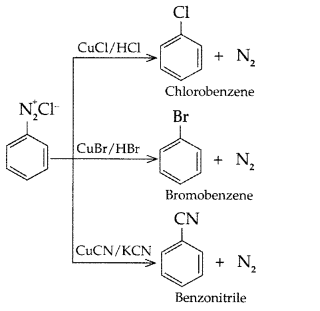
Important Questions for Class 12 Chemistry Chapter 13 Amines Organic Compounds Containing Nitrogen Class 12 Important Questions 74

Question 69.
Identify A, B and C in the following reactions : (Comptt. Delhi 2017)

Important Questions for Class 12 Chemistry Chapter 13 Amines Organic Compounds Containing Nitrogen Class 12 Important Questions 75
Answer:
Important Questions for Class 12 Chemistry Chapter 13 Amines Organic Compounds Containing Nitrogen Class 12 Important Questions 77

Question 70.
Identify A, B and C in the following reactions : (Comptt. All India 2017)

Important Questions for Class 12 Chemistry Chapter 13 Amines Organic Compounds Containing Nitrogen Class 12 Important Questions 76
Answer:
Important Questions for Class 12 Chemistry Chapter 13 Amines Organic Compounds Containing Nitrogen Class 12 Important Questions 77

Amines: Organic Compounds Containing Nitrogen Class 12 Important Questions Long Answer Type [LA]

Question 71.
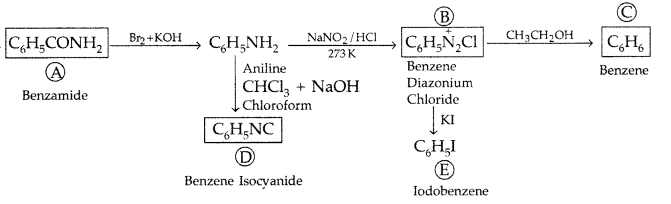
An aromatic compound JA’ of molecular formula C7H27ON undergoes a series of reactions as shown below. Write the structures of A, B, C, D and E in the following reactions : (Delhi 2015)
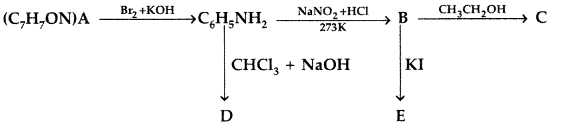
Important Questions for Class 12 Chemistry Chapter 13 Amines Organic Compounds Containing Nitrogen Class 12 Important Questions 78
Answer:
Important Questions for Class 12 Chemistry Chapter 13 Amines Organic Compounds Containing Nitrogen Class 12 Important Questions 79

Question 72.
(a) Write the structures of main products when aniline reacts with the following reagents :
(i) Br2 water (ii) HCI (iii) (CH3CO)2O/pyridine
(b) Arrange the following in the increasing order of their boiling point :
C2H5NH2, C2H5OH, (CH3)3N
(c) Give a simple chemical test to distinguish between the following pair of compounds : (CH3)2NH and (CH3)3N (Delhi 2015)
Answer:
(a) (i) Br2 water
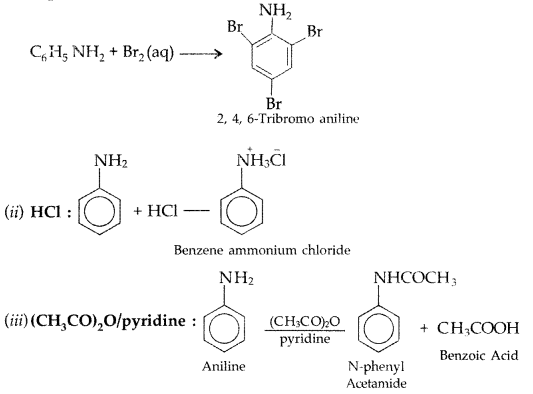
Important Questions for Class 12 Chemistry Chapter 13 Amines Organic Compounds Containing Nitrogen Class 12 Important Questions 80

(b) Increasing order of boiling point :
(CH3)3 < C2H5NH2 < C2H2OH

(c) By Hinsberg test, secondary amines or (CH3)3NH shows precipitate formation which is insoluble in KOH. Tertiary amines or (CH3)3N do not react with Hinsberg’s reagent (benzene sulphonyl chloride).

Question 73.
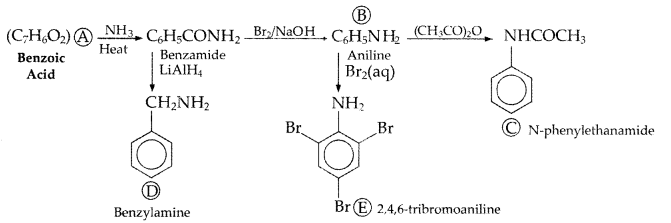
An aromatic compound ‘A’ of molecular formula C7H6O3 undergoes a series of reactions as shown below. Write the structures of A, B, C, D and E in the following reactions : (All India 2015)
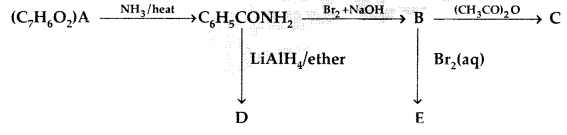
Important Questions for Class 12 Chemistry Chapter 13 Amines Organic Compounds Containing Nitrogen Class 12 Important Questions 81
Answer:
Important Questions for Class 12 Chemistry Chapter 13 Amines Organic Compounds Containing Nitrogen Class 12 Important Questions 82

Question 74.
(a) Write the structures of main products when benzene diazonium chloride reacts with the following reagents :
(i) H3PO2 + H2O (ii) CuCN/KCN (iii) H2O
(b) Arrange the following in the increasing order of their basic character in an aqueous solution :
C2H5NH2, (C2H5)2NH, (C3H5)3N
(c) Give a simple chemical test to distinguish between the following pair of compounds :
C6H5—NH2 and C6H5—NH—CH3 (All India 2015)
Answer:
(a) The structure of main products when aniline (benzene diazonium chloride) reacts with the following reagents :
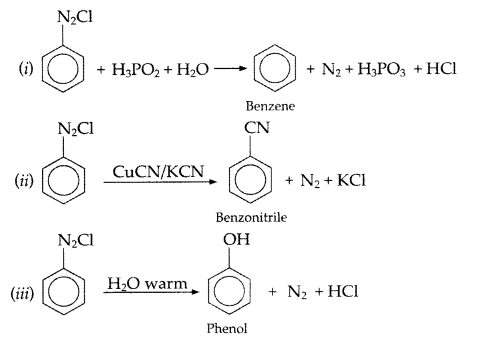
Important Questions for Class 12 Chemistry Chapter 13 Amines Organic Compounds Containing Nitrogen Class 12 Important Questions 83
(b) C2H5NH2 < (C3H5)3N < (C2H5)2NH
(c) Aniline and Benzylamine can be distinguished by the Nitrous acid test. Benzylamine reacts with HNO2 to form a diazonium salt which being unstable even at low temperature, decomposes with evolution of N2 gas.
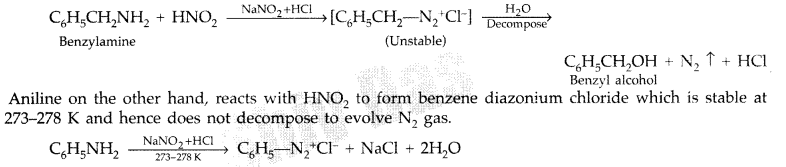
Important Questions for Class 12 Chemistry Chapter 13 Amines Organic Compounds Containing Nitrogen Class 12 Important Questions 84

acid base and salt pyq 2023


 Part - A

acid base and salt -  PYQ 2023

  1. Few drops of aqueous solution of ammonium chloride are put on a universal indicator paper. The paper turns pink.
    Study the following table and choose the correct option. [1 mark] [ CBSE 2023]
  2. Two salts ‘X’ and ‘Y’ are dissolved in water separately. when phnolphthalein is added to these two solutions, the solutions ‘X’ turns pink and the solution ‘Y’ does not show any change in colour, therefore ‘X’ and ‘Y’ are
    a. X is Na2CO3 and Y is NH4Cl
    b. X is Na2SO4 and Y is NaHCO3
    c. X is NH4Cl and Y is Na2SO4
    d. X is NaNO3 and Y is Na2SO4 [1 mark] [CBSE 2023]
  3. There are four solutions A, B, C and D with pH values as follows :-

    Which solutions would liberate hydrogen gas with zinc ?
    a. A only
    b. D only
    c. A and D only
    d. B and c only [1 mark] [CBSE2023]
  4. Assertion (A) : It is advised that while diluting an acid one should add water to acid and not acid to water keeping the solution continously stirred.
    Reason (R) : The process of dissolving an acid into water is highly exothermic.
    Answer the question selecting appropriate options given below :
    a. Both Assertion (A) and Reason (R) are true and Reason (R) is the correct explanation of (A).
    b. Both Assertion (A) and Reason (R) are true but Reason (R) is not the correct explanation of (A).
    c. Assertion (A) is true, but Reason (R) is false.
    d.Assertion (A) is false, but Reason (R) is true. [1 mark] [CBSE 2023]
  5. A solution turns the colour of turmeric to reddish brown. if the same solution is poured on universal indicator, its colour would chhange to :
    a. violet
    b. blue
    c. red
    d. green [1 mark] [CBSE 2023]
  6. If 10 ml of H2SO4 is mixed with 10 ml of Mg(OH)2 of the same concentration, the resultant solution will give the following colour with universal indicator:
    a. Red
    b. yellow
    c. Green
    d. Blue [1 Mark] [CBSE 2020]
  7. . A substance ‘X’ is used as a building material and is insoluble in water. when it reacts with dil. HCl, it produces a gas which turns lime water milky.
    1. Write the chemical name and formula of ‘X’.
    2. Write chemical equations for the chemical reactions involved in the above statements. [3 mark] [CBSE 2023]
  8. A metal ‘M’ on reacting with dilute acid liberates a gas ‘G’. The same metal also liberates gas ‘G’ when reacts with a base.
    1. Write the name of gas ‘G’.
    2. How will you test the presence of this gas?
    3. Write chemical equations for the reactions of the metal with (i) an acid and (ii) a base. [3 marks] [CBSE 2023]
    1. what property do acids and bases have in common ? Explain it with an example.
    2. A compound which is prepared from gypsum has the property of hardening when mixed with water.
      Identify the compound and write its formula. How is this compound prepared ? Describe it in the form of a chemical equation only. [3 mark] [CBSE 2023]
    1. Write the chemical name and molecular formula of tooth enamel.
    2. How does it get corroded ? What is the preventive measure for this ? [3 mark] [CBSE 2023]
  9. A chemical compound ‘X’ is used in the soap and glass industry. It is prepared from brine.
    1. Write the chemical name, common name and chemical formula of ‘X’.
    2. Write the equation involved in its preparation.
    3. What happens when it is treated with water containing Ca or Mg salts? [3 Marks] [CBSE 2020]
  10. Write the chemical formula of washing soda. How can it be obtained from baking soda ? List two industries in which washing soda is used for other purposes than washing clothes. [3 Marks] [CBSE 2019]
  11. State the effect of concentration of H+ (aq) ions on the nature of the solution. Do basic solutions also have H+ (aq) ions ? If yes, then why are these basic? [3 Marks] [CBSE 2019]
  12. 2 mL of sodium hydroxide is added to a few pieces of granulated zinc metal taken in a test tube. When the contents are warmed, a gas evolves which is bubbled through a soap solution before testing. Write the equation of the chemical reaction involved and the test to detect the gas. Name the gas which will be evolved when the same metal reacts with dilute solution of a strong acid. [3 Marks] [CBSE 2018]
  13. The pH of salt used to make tasty and crispy pakoras is 14. Identify the salt and write a chemical equation for its formation. List its two uses. [3 Marks] [CBSE 2018]


Part - B
1 Mark:

1. How does the flow of acid rain water into a river make the survival of aquatic life in the river difficult? [CBSE, 2008]
2. What effect does an increases in concentration of 𝐻+(𝑎𝑞. ) in a solution have on the 𝑝𝐻 of solution?
[CBSE, 2009]
3. During summer season, a milkman usually adds a very small amount of baking soda to fresh milk. Give one reason.
[CBSE Sample Paper 2008]
4. Dry Hydrogen Chloride gas does not turn blue litmus red whereas Hydrochloric acid does. Give one reason.
[CBSE Sample Paper 2008]
2 Marks:
1. Write the chemical formula for washing soda. How may it be obtained from baking soda? Name an industrial use of
washing soda other than washing clothes.’
[CBSE, 2008]
2. I. Name the products formed when sodium hydrogen carbonate is heated.
II. Write the chemical equation for the reaction involved in the above.’
[CBSE, 2009]
3 Marks:
1. Baking soda is used in small amount in making bread and cake. It helps to make these soft and spongy. An aqueous
solution of baking soda turns red litmus blue. It is also used in soda acid fire extinguisher.
Use this information to answer the following questions:
I. How does Baking Soda help to make cakes and bread soft and spongy?
II. How does it help in extinguishing fire?
III. is the 𝑝𝐻 value of baking soda solution lesser than or greater than 7?
[CBSE Sample Paper 2008]
2. Answer the following:
[CBSE Sample Paper 2008]
a) Why is Plaster of Paris written as 𝐶𝑎𝑆𝑂4 ⋅ ½ 𝐻2𝑂? How is it possible to have half a water molecule attached to
𝐶𝑎𝑆𝑂4?
b) Why is Sodium Hydrogen Carbonate an essential ingradiant in antacids.?
c) When electricity is passed through an acquous solution of sodium chloride, three products are obtained. Why is
the process called chlor-alkali?
3. “𝑝𝐻 has a great importance in our daily life” explain by giving three examples.
OR
A compound which is prepared from gypsum has the property of hardening when mixed with a proper quantity of
water. Identify the compound and write its chemical formula. Write the chemical equation for its preparation. Mention
any one use of the compound. 

Part - C

Bleaching powder is soluble in cold water giving a
milky solution due to-
(a) available chlorine
(b) lime present in it
(c) calcium carbonate formation
(d) The absorption of carbon dioxide from atmosphere
Ans : (b) lime present in it
Bleaching powder is actually a mixture of calcium
hypochlorite CaOCl2 and the basic chloride CaCl2
with some slaked, Ca OH ( )
2 .
21. Reaction of an acid with a base is known as-
(a) decomposition (b) combination
(c) redox reaction (d) neutralization
Ans : (d) neutralization
In a neutralization reaction an acid reacts with a base
and forms salt and water.
22. Which of the following acid does not react with metals-
(a) sulphuric acid (b) phosphoric acid
(c) carbonic acid (d) nitric acid
Ans : (c) carbonic acid
23. Bleaching powder gives smell of chlorine because it-
(a) is unstable
(b) gives chlorine on exposure to atmosphere
(c) is a mixture of chlorine and slaked lime
(d) contains excess of chlorine
Ans : (b) gives chlorine on exposure to atmosphere
 

Sunday, August 6, 2023

Assignment icse chemistry class 9th

 Prepared by Akhilesh tiwari 

SECTION - 1

  1. Balance the following equations :
    1. CaCO₃ (s) +HCl (aq) → CaCl₂ (aq) + H₂O (l) + CO₂(g)
    2. Zn (S) + HCl (aq) → ZnCl₂ (aq) + H₂ (g)
    3. MnO₂ (s) + HCl (aq) → MnCl₂(aq) + H₂O (l) + Cl₂ (g)
    4. Na₂CO₃ (s) + H₂SO₄ (aq) → Na₂SO₄(aq) + H₂O (l) + CO₂ (g)
    5. Mg₃N₂(s) + H₂O (l) → Mg(OH)₂ (s) + NH₃(g)
    6. NH₃ (g) + O₂ (g) → N₂ (g) + H₂O (l)
    7. MgCl₂ (aq) + Na₂CO₃ (aq) → MgCO₃ (aq) + NaCl (aq)
    8. Pb3O4àPbO + O2
    9. P + HNO3à NO2 + H2O + H3PO4
    10. NO2 + H2O à HNO2 + HNO3
    11. PbO + NH3àPb + H2O + N2
  2. Write the formulae and balance the following equation :
    1. Zinc + dil. Sulphuric acid → Zinc sulphate + hydrogen.
    2. Ammonium sulphate + calcium hydroxide → Calcium sulphate + ammonia + water.
    3. Lead dioxide + hydrochloric acid → Lead chloride + water + chlorine.
    4. Aluminum oxide + sulphuric acid → Aluminum sulphate + water.
    5. Iron + conc. Sulphuric acid → Iron sulphate + sulphur dioxide gas + water.
  3. What is the valency of :
    1. Fluorine in CaF₂
    2. Sulphur in SF₆
    3. Phosphorous in PH₃
    4. Carbon in CH₄
    5. Nitrogen in the following compounds : N₂O₃ , N₂O₅ , NO₂ , NO.

SECTION - 2

  1. What are the limitations of chemical equation ?
  2. MNO₃ is a formula of a nitrate of a metal M. write down the formulae of :
    • Oxide of M
    • Nitride of M
    • Sulphate of M
    1. Explain the term ‘valency’ and ‘variable valency’.
    2. How are the elements with variable valiancy named ?
  3. What do you understand by the term chemical formula ? What information is given by the formula NH3 ?
  4. Define balanced and unbalanced equation .
  5. Give the names of the following compounds :
    Cu2O, CuO , Hg2O, HgO, FeO, Fe2O3
  6. What are the information conveyed by a chemical equation?

Saturday, July 15, 2023

Atomic structure|| class 11th

 prepared by AKHILESH TIWARI 


UNIT 2 STRUCTURE OF ATOM

According to Dalton theory of atom(1808) - 

  •         All matter is composed of extremely small particles called atoms.
  • ·        The atom consists of smaller particles such as electron, proton and neutron.
  • ·        These particles are regarded as fundamental particles.
  • ·        Dalton theory explained the laws of chemical combination

·        Dalton couldn’t explain the charge produced by rubbing ebonite

 with silk or fur.

DISCOVERY OF ELECTRONS

The electrons were discovered by conducting an experiment by using a simple apparatus known as Cathode rays Discharge tube  tube or Crookes tube.

  • ·        It  consists of a sealed glass tube of about 50 cm lengths.
  • ·        Two metal electrodes are fused to the ends.
  • ·        A side tube is connected to a vacuum pump.
  • ·        The discharge tube is filled with a gas under study.
  • ·         The two electrodes are connected to a source of high voltage (1000 V) And very low pressure .
  • ·        Croockes said that at very low pressure, air being conductor of electricity.


OBSERVATIONS  and properties :

  • ·        When the discharge tube containing the gas is at 1 atm pressure and at high voltage, the gas remains non conducting.
  • ·        When the pressure of the gas inside the tube is less than 1 mm of mercury, a dark space appears near the cathode.  This is known as Crookes dark space.
  • ·        When the pressure is reduced to 0.01 mm Hg, it fills the entire tube.
  • ·        When the pressure is further reduced to 10-4 mm Hg, the electric discharge passes between the electrodes  wall of  the tube  coated with ZnS (fluorescent screen) begins to glow.
  • ·       


This is due to the striking of some invisible rays from the cathode.

  • ·        These rays which start from the cathode and move towards the perforated anode, so called cathode rays.
  •    • They move in straight lines.
  • • These rays are called cathode rays or cathode ray particles.
  • • These rays deflect towards anode. These rays consist of negatively charged material particles called electrons.
  • • Properties of cathode rays don’t depend upon cathode material or gass filled in discharge tube.
  • • Cathode rays produce mechanical effects.
  • • It indicates that cathode rays themselves are negatively charged.
  • • When a magnetic field is applied perpendicular to the path of cathode rays, they  get deflected in the direction expected for negative particles. This direction of deflection shows that cathode rays are –vely charged.
  • When cathode rays are allowed to strike a thin metal foil, it gets heated up.
  •  Cathode rays produce, x-rays when they strike heavy metals like tungsten, copper etc.
  •  Cathode rays produce fluorescence on glass walls, ZnS etc.
  •  Cathode rays penetrate through thin metallic foils.
  •  Cathode rays affect photographic plates.
DETERMINATION OF CHARGE TO MASS RATIO (e/m) OF ELECTRONS
  •  In 1897 J.J. Thomson determined the e/m of the electron.
  •  He measured the deflection of cathode rays under the simultaneous influence of electric and magnetic fields.
  •  A narrow beam of cathode rays is generated by electric discharge in a gas at low pressure.
  •  If an electric field is applied at right angles to the beam, the beam having negative charge is attracted to the positive plate of the field.
  •  the beam thus travels a parabolic path and strikes at another point on the screen.
  •  A magnetic field is now applied to the beam in a direction at right angles to that of the electric field.
  •  The beam undergoes deflection in the opposite direction.
  •  Deflection ∝ strenght of magnetic feild and electric field. 
                Deflection ∝ magnitude of negative charge. 
                Deflection ∝ 1/ mass of particles.  
  •   The strength of the two fields are so adjusted that the beam strikes the screen at the original position.

  •  Lighters the particle greater the deflection in the field.
  •  As voltage of electric field and strength of magnetic field increase deviation from orginal pathway increases .


           e – charge of electron
           Me – mass of electron

Charge on the electron


The charge of an electron was determined by Robert Millikan in 1909 by oil drop

experiment.

  • ·        In this method, a spray of oil droplets is produced by an atomizer.
  • ·        The oil droplets enter the apparatus through a small hole.
  • ·        It allowed to fall in between two charged plates.
  •         The motion of the droplets is observed with a telescope.
  • ·        The space between the charged  plates is irradiated with x-rays.
  • ·        The x-rays ionize the molecules of the air.
  • ·        One or more electrons produced may be absorbed by an oil droplet.
  • ·        The oil droplet as a result becomes negatively charged.
  • ·    By measuring the velocity of a given oil droplet as it falls freely under the influence of gravity and then in an electric field, it is possible to calculate the charge on the droplet. Q= n e
  • ·    This charge is considered to be electronic charge.
  • ·     The charge on the electron is found to be - 1.602 x 10⁻¹⁹ coulombs.


Atomic structure

Atomic  Atomic structure structure